Sunday, June 12, 2011

Positive Interventions and ASD (Kate Altman, M.S.)

This week I will be presenting a workshop called "Positive Psychology Interventions for Adults and Children with ASD" with Dr. Katherine Dahlsgaard and Tim Wilson at the Pennsylvania Psychological Association's annual convention. The convention serves psychologists and psychology students in Pennsylvania.

As the title indicates, our workshop will focus on using positive interventions in working with individuals and groups on the autism spectrum. Positive interventions (based on positive psychology, the scientific study of strengths: http://www.ppc.sas.upenn.edu/) are tools that can help a person think more creatively and more openly, enhance mood, and build self-esteem. For example, one of the interventions we talk about is simply monitoring positive moods--taking the time each day to pay attention to positive moods when they occur (even if they are fleeting) and focusing on what they feel like physically (the stretch of a smile on your face) and internally (slower, clearer thoughts; flow of creative ideas).

Positive psychology and positive interventions often seem very simplistic in explanation, yet when they are exercised they can be profoundly effective.

What do you think of the notion of focusing on the positive in therapy (not exclusively, but sometimes)? What do you think about using these methods with kids, adolescents, and adults on the autism spectrum?


Monday, June 6, 2011

My Autism Journey (Liz McGarry)


After silently filing into the room, I hesitantly took a seat in a small wooden chair against the wall. The rest of my peers, a small group of fifth-grade students selected for this very special mission, joined me in the back of the room. Although we carefully eyed the five little children squirming in their desks, they didn’t seem to mind or even notice our intrusion into their classroom. Before the teacher could introduce us, a piercing shriek broke the silence. I quickly turned to my right to discover the source of the noise—a small child barreling toward me with the fury of a professional wrestler! Smack. Mrs. C darted across the room just as little Albert slapped my arm with all of his might. Fortunately, Albert did not have the strength of a professional wrestler. I wasn’t hurt, but I can’t say that I was too happy either. What just happened? “Sorry Elizabeth,” Mrs. C explained, “You see…you’re sitting in Albert’s chair.”

At the age of eleven, I was selected to be a student volunteer in Mrs. C’s autistic class: my first encounter with autistic children. But it would not be my last. My name is Liz McGarry, and I am now a junior at Tufts University studying child development and psychology. I am currently working as an intern for Alternative Choices, as well as the Center for Autism Research in Philadelphia. You might be thinking, after such a violent introduction to the world of autism, what would inspire me to continue to study it and pursue a career involving autistic children? For me, it was the desire to unlock the mysteries of the disorder and to help children like Albert who have so much trouble communicating even their most basic needs.

I now know a lot more about autism than I did in fifth grade, but I still have a lot to learn. New discoveries are always being made as I race to catch up on all of the interesting articles and research that is already out there. Family and friends who know of my “autism obsession” constantly forward me news clips or articles about autism, and I love passing them on to others. I am grateful for the opportunity to use this blog to share my journey toward an autism education, as I learn more about the signs, treatments, and causes of this mysterious disorder.

Friday, June 3, 2011

Pick Your Battles, Win the War (Kate Altman, M.S.)

“Pick your battles.” That’s the best piece of advice I learned from a (very strict, actually) behavioral therapist when I was new in the field.

I glimpsed my future yesterday when I had lunch with a good friend and her two-year-old. Or, I should say I ate my lunch while she chased him around the (kid-friendly restaurant) telling him things like, “Don’t take those toys. They aren’t yours!” and, “Stop playing with that water. That’s for washing your hands…you’re spraying people!” She’d sigh in exasperation as he’d inevitably respond with a resounding, “No!” while continuing to do whatever he was doing. At one point she turned to me with an expression of defeat and said, “The terrible twos. And I hear the threes are worse!” I was exhausted just thinking about it.

Discipline and boundaries are extremely important in raising children. They keep your child safe (“Never run into the street”), help them learn self-regulation, and make them sociable and likable so they can be successful with others.

However, constantly disciplining and going head to head with a child can actually backfire, plus it can lead to exhaustion and demoralization for the parent. Therefore, sometimes you just have to pick your battles; focus on what’s most important and be consistent with warnings and consequences. Parents who take a moderate, authoritative approach often seem to have a great deal of success in disciplining their children. Hopefully I will remember these strategies in a couple of years!

Sunday, May 29, 2011

Loner Style (Kate Altman, M.S.)

While we were dating, my husband, Jon, and I would joke that someday we would have the perfect child (and of course we did! Haha) because in some ways we are so different that we complement each other and fill in each other’s gaps. One of our major differences is that I am extremely people-oriented and social and he is a natural loner. I am forever dragging him to dinners with new friends (I recently asked him to do an impression of me…and he immediately launched into a peppy monologue that began: “Oh my gosh I met this amazing woman today! Her name is Alison and she is so smart and interesting and we have so much in common! You will love her! And it sounds like her husband is a lot like you so you two will hit it off…We’ll find out because I made plans for us to have dinner with them this weekend!”). Jon is almost always a good sport and he usually has a great time at these social outings. He is funny and sweet and people love him (again, of course!).

I just began reading the popular psychology book, “Party of One: The Loner’s Manifesto” by Anneli Rufus (given to me, appropriately, by my mother-in-law). The book posits that being a loner is a healthy—if not superior—state and that we live in a society that pathologizes “loner-ism”. After all, we have mental health diagnoses like Avoidant Personality Disorder and the typical image of a person with Major Depression is someone who withdraws socially, yet we don’t have an “Overly Social Personality Disorder” or worry about someone who is forever engaging with others.

Jon simply needs alone time (which can include me and our daughter) to retreat from the social world, decompress, and focus on independent activities like playing music and reading. While I have never stuck with a hobby besides reading (I have a whole trunk full of half-finished knitting projects), Jon has taught himself to play guitar, to cook and bake, to fix things and garden. He can entertain himself for hours; he reads books and writes jokes and notes to himself in the margins. He almost never gets bored or stir crazy, which I most certainly do after a few hours in the house.

Being a loner does not mean a person is lonely, depressed, or antisocial. It is simply a personality style, and a valuable one.

Are you a loner? Do you feel pressured to behave more socially than you would like?

Thursday, May 19, 2011

Finding a Therapist (Kate Altman, M.S.)


Ever since I entered the mental health field, friends and family have approached me to ask for referrals and ask for advice about how to find a good therapist. Unfortunately, I heard many stories from people who tried therapy but gave up when the first therapist they tried was unhelpful, unethical, or just not a great match for them. This article from NPR offers some good tips to help you "shop" for a good therapist: http://www.npr.org/2011/05/16/136283080/shop-for-a-pyschotherapist-to-avoid-the-lemons

As the article points out, there are many different types of therapy, and it can be overwhelming to sift through all of the types of therapy and various therapists out there...especially if you are suffering from mental health issues like depression or anxiety. But I do recommend doing some research if you can...or enlisting the help of a trusted friend or family member to help you. If you have a sense of what your diagnosis/problem may be, you can pretty easily discover what types of therapy have evidence for treating that diagnosis (such as exposure therapies for trauma, CBT for specific forms of anxiety, and psychodynamic therapy for interpersonal issues). It is also important to consider your personality and personal preferences. Are you a short-term, solution-focused thinker, or do you prefer analyzing relationships and exploring emotions over a long period of time? Do you want a therapist in a didactic, authoritative role or do you prefer a collaborative approach? Having at least a sense of what works for you can help you weed through lists of potential therapists and ask good questions when you interview them over the phone and/or in the first session (and don't be shy about doing so!).

Though doing some research and taking the time to speak with a few different therapists may feel overwhelming when you are in need, it is worth the effort. Don't be afraid to ask people you trust for referrals: word of mouth is often still the best way to find someone good. Above all, don't give up Even if you don't love the first (or second) therapist you meet, keep looking...the perfect fit is out there.


Monday, May 16, 2011

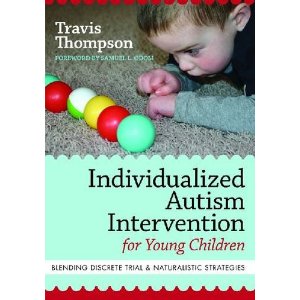
New Book: Individualized Autism Treatment

30 years ago this month, my son’s autistic symptoms emerged. Having lived with autism in the family for almost 3 decades, Individualized Autism Intervention for Young Children: Blending Discrete Trial and Naturalistic Strategies, is quite simply, in my opinion, the best book yet in sorting out what we know and what we can do to alter the course of autism in young children. As an expert senior psychologist and grandparent, Travis Thompson has given us a ground breaking contribution based upon solid theory and emerging research evidence.

From the Brookes Publishing web site: “Discrete trial instruction or naturalistic, incidental teaching: How do you choose which approach to use with young children with autism? Now there's no need to ‘pick a side’—this groundbreaking book helps professionals skillfully blend the best of both behavioral approaches to respond to each child's individual needs… this guidebook cuts through the chaos of conflicting information and gives readers a logical, child-centered way to plan and implement intervention.”

I am particularly excited about the possibilities for the Autism Intervention Responsiveness Scale, Research Edition, which is included in the book. This scale gives professionals an in-depth guide to creating an autism intervention profile for each child, based on the type and severity of the child's autism characteristics. By completing the profile, readers can then match individual characteristics and needs with a specially tailored blend of discrete trial and developmentally oriented naturalistic teaching.

On the other hand, I am deeply troubled by budget cuts that threaten services vitally necessary for children with autism and their families. As Thompson notes, “Most evidence indicates that 25-30 hours per week of one-to-one intervention over the first 1-2 years is required to make significant gains in core autism symptoms for children who are responsive to this form of treatment.” (p.41)

The time is now for professionals and families to push back through our organizations and the political process for what children need and deserve to have the best life possible.

Read an interview with Doctor Thompson at http://www.brookespublishing.com/autism/authors/thompson.htm

Tuesday, May 3, 2011

A Mothers Day Plan for Dads

Why is it so hard for moms to take a break? Renowned child psychiatrist, Donald Winnicott (1896-1971)said that struggling with taking a break from maternal responsibilities is normal. “Primary maternal preoccupation is a consuming attachment to one’s baby, a normal sickness from which most mothers recover.” He was talking about the mothers of typical children—who presumably have a little less to be preoccupied with on the average than mothers of children who have autism and other special needs. So it’s normal, but when it goes on indefinitely, it’s not healthy.


Winnicott appeared regularly on public radio in the United Kingdom. When asked how he knew so much about mothers, he responded that most of what he learned came from listening to mothers. He also wrote, “I think mothers are helped by being able to voice their agonies at the time they are experiencing them. Bottled up resentment spoils the loving which is at the back of it all.”

Opening up and connecting about upsetting situations can help. On the other hand, suggesting that a mother do more to take care of herself often makes her feel worse. Listening to mothers in our practice at Alternative Choices, we hear that this can sound like just one more thing to do. And another thing they just aren’t getting right-- even more guilt!

In contrast, the average overwhelmed father seems to have less difficulty taking a break. He may also have trouble talking about what he cannot fix or take action about, which offers no outlet for his partner’s feelings. He may shut down out of helplessness and emotional overload that he has no words for. The very same man may love his partner and children passionately; yet he may feel left out and ignored.

Still, most fathers admire when the mother of their children reacts like a mother lion with her cub, doing everything possible to raise their child.

So for this Mothers and Day and every day really, here’s a plan for men. Tell your partner how much you appreciate her and everything she does for your children. Be specific about all the wonderful things she does and how hard she tries. Ask what you can do to make her job easier. Gently and persistently keep asking and showing up to do stuff. This is how to be a good man in your situation. Help her to take a breath, literally and figuratively. Most likely you will be helping her feel better—it may even lead to her taking a break.